
Vero's migration to GreenArrow
Success Story: Vero’s migration to GreenArrow
We recently had an opportunity to sit down with Chris Hexton, co-founder and CEO at Vero, and Reba Moyes, Operations, to discuss their migration from their previous email delivery vendor to GreenArrow’s cloud service in 2025.
Vero has been in business for 12+ years, and has been delighting their users with a no-nonsense, multi-channel customer engagement platform for product-led teams. Vero provides intuitive email, push, and SMS editors, along with its visual journey builder, integrations, and flexible API. Their product is built on three foundational principles: make it easy to connect to source data, treat marketing operations as a center of excellence, and build great UX for the end user.
Why did you decide to switch vendors?
Chris Hexton: The initial “germ” was to look around and consider our options: we had been with our previous vendor for over a decade, and they’ve been great to work with, but we also knew that we had matured as a company and that we have more knowledge ourselves.
We thought, “it’s a good time to go to market to both see if we’re getting good value cost-wise and if there’s any tooling that can give us more flexibility. Can we do more? Have more control? Etc.” And so that’s what really kicked it off. And then we spoke to a whole bunch of different vendors, and met GreenArrow, which we hadn’t heard of before.
Reba Moyes: The cost savings in particular were very, very appealing. We decided, “Let’s go out to the market and really get a sense of what’s going on at this particular time.” Once we went out into the market we realized we could make significant cost savings by switching providers. This wasn’t the case five years ago.
Why did you choose GreenArrow as your new vendor?
Chris Hexton: In the end it was a combination of three things: firstly, as GreenArrow is actually MTA software, there’s a lot of scope for flexibility as we grow. Secondly, the price was very effective: it enabled us to save a bunch of money over our old vendor, so that’s super helpful.
And finally, like us, GreenArrow is a smaller team than some of the other players in the space. That felt like kinship to us. We think we do a really good job when it comes to service for our customers, sometimes by virtue of being a smaller player in the space. And, in talking to GreenArrow, that felt true for the sort of service we’d get from GreenArrow, and that has definitely held true now that we’ve been working together.
Reba Moyes: We were really intrigued by GreenArrow’s combination of cloud and OnPrem offerings. It signaled flexibility and a future-proof path for us, which mattered because we knew that once we switched providers, we’d likely be committing for a long time.
We seriously considered OnPrem, but ultimately realized that allocating team resources for the ongoing management of the solution wasn’t the right move for us right now. Starting with the cloud product made sense because it allowed us to work closely with GreenArrow and leave the door open to OnPrem later.
Beyond the product itself, GreenArrow’s direction and philosophy really stood out. Other providers felt more traditional in how they approached both the technology and the customer relationship. With GreenArrow, the team dynamic and way of working felt closely aligned with how we operate and how we support our own customers. It was very different to the larger, more traditional providers in terms of the relationship that we could build.
We were lucky because we had joined when our former provider was relatively small in comparison to where they are now. We had a very good, close relationship with them but again – it was just different and more closely resembled the classic service provider/customer dynamic. With GreenArrow, the partnership felt more direct and collaborative. Ultimately, the team and how they work was a major reason we chose them.
What was the migration like?
Reba Moyes: Before the migration, our team reviewed what updates might be required for any new tool and identified a few internal changes we needed to make. Given we’d been with our existing provider for over a decade we’d optimised certain aspects of our integration for them that would not apply elsewhere. And then the migration process ended up being quite straightforward and smooth for us from an overarching project management perspective
GreenArrow’s technical documentation was clear and we had weekly check-ins with the team to work through any questions we had around implementation. When it came time to migrate domains we had three months of historical data in the Postmastery Console which was especially valuable in establishing a baseline for engagement metrics. We then worked with GreenArrow to create a migration guide, defining which domains to move and how to monitor them—daily at first, then weekly. Knowing when to pause and let things settle helped ensure a smooth transition over three to six months. GreenArrow’s vigilance and deliverability expertise made the process as smooth as we could have hoped for, giving us confidence that nothing would be missed and any issues would be addressed immediately.
Of course, with any migration, unexpected issues can arise. We were particularly concerned about deliverability given the scale of the change – we help our customers migrate, but we have always had our former vendor as a base partner. We really didn’t imagine that the GreenArrow team would be working so closely with us on deliverability specifically, and that was a lovely surprise. We were really happy with how the migration went. All in all, this was a great project.
Chris Hexton: Our goal was that the migration wouldn’t have any deliverability impact at all. And I think, for the most part, that’s been true. A lot of our mid-market customers don’t do advanced deliverability monitoring and instead rely on on open and click metrics, which means they entrust us with their deliverability. It was a core part of our migration plan to ensure that inbox placement and open and click were the same before, during and after the migration. In a lot of cases they’ve been better after.
Some of our customers, particularly the ones that are larger, tend to do more sophisticated inbox placement testing and have a much more fine-grained ability to detect changes. We also haven’t had any major issues with any of those customers, and didn’t throughout the migration.
We were pretty conservative in how we rolled out the warm up, and I think that helped a lot. We didn’t rush anyone onto GreenArrow, and I think that’s paid dividends in that we haven’t had customers emailing us saying, “Hey! Everything’s going to spam now.” or “Our open rate has cratered. What’s going on?”
Further, the data we are getting is more powerful than what we had before so, if anything, we’re able to pick things up that we couldn’t before and help customers even further.
Deliverability Comparison between GreenArrow and the former system
Vero connected both their former vendor and GreenArrow to the Postmastery Console to gather a baseline of statistics prior to the migration and to monitor relative statistics while the migration happened.
During the migration, email traffic was split between the former vendor and GreenArrow, with a statistically random portion going to GreenArrow. This percentage was controlled and slowly increased for each customer. Because the segment was random, this allowed relative metrics, such as Open Rates and Bounce Rates, to be compared between identical traffic where the only difference was the delivery vendor.
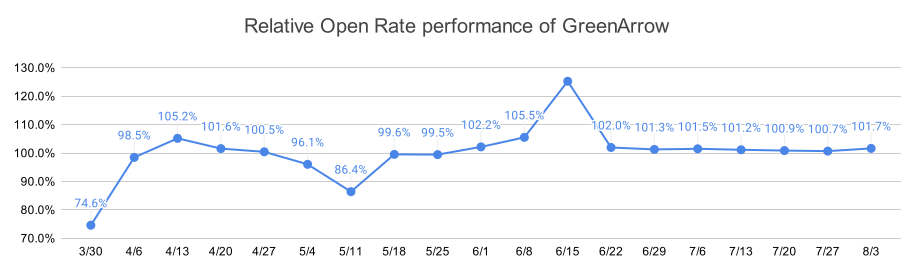
The primary comparison metric was the Open Rate of the GreenArrow segment of the email traffic divided by the Open Rate of the former vendor’s segment of the email traffic. 100% means that the two vendor’s Open Rates were identical. 110% means GreenArrow’s open rate is better: for example, 33% opens on GreenArrow vs 30% opens on the former vendor. And 90% would mean GreenArrow was performing more poorly, such as 27% opens on GreenArrow and 30% on the former vendor.
This graph shows, for each week, a weighted average across all Vero customers of this relative performance metric, weighted by the total volume of each customer:
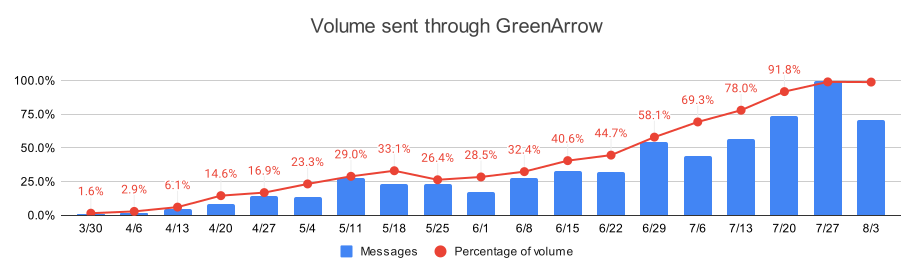
In the above graph, the red line is the percentage of volume sent through GreenArrow, compared to the entire volume. The blue bars are the total number of messages sent through GreenArrow for each week, scaled so that the largest week is 100.
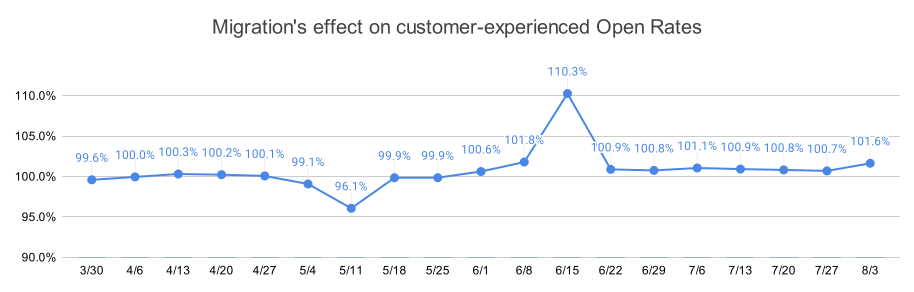
The above graph shows the overall impact on the Open Rates experienced by customers. This takes into account both the relative performance of GreenArrow and the percentage of volume sent through GreenArrow compared to the former vendor. For example, if the relative performance of GreenArrow is 110% and 50% of email is sent through GreenArrow, this metric will be 105%, indicating the customer will experience a 5% boost in open rates due to the migration.
Notable points:
-
The worst relative results were in week one at 74.6%, as the warmup was just beginning and the new reputation was being built. However, because just 1.6% of the total volume was sent through GreenArrow, the overall customer impact, as shown on the third chart, was negligible at 99.6%.
-
In the 7th week (the week of 5/11), the relative performance temporarily fell to 86.4%. This was due to the volume increasing by a factor of 2x from the previous week, which proved slightly too fast at this point in the warmup, even though the percentage of volume sent through GreenArrow only increased from 23.3% to 29.0%. The following week the total volume didn’t increase and the relative performance of GreenArrow returned to 99.6%.
-
Other than the 7th week, the overall effect on customer-experienced Open Rates was never below 99%.
-
After the 10th week of the migration, the relative performance of GreenArrow was always above 100%.
What has it been like working with GreenArrow?
Chris Hexton: Reiterating all the things I’ve said, GreenArrow has genuinely been great to work with. The email space is an interesting space: I think it’s super impressive that GreenArrow is out there with a totally custom built MTA software taking on the “big dogs,” and I think it’s great to have that choice in the market. It can be easy with any software vendor to get swayed by the first name that you hear, but people should do their research and really look into what’s possible with the software and what it’s like to work with the team. We are super happy with our choice, and we can only speak really highly of working with GreenArrow to date.
Reba Moyes: We found working with the GreenArrow team to be really exceptional. That’s such a massive thing- particularly in this market where the ESPs are large, multi-product and always acquiring, there is always movement. It’s really kind of a unique experience to work with such a knowledgeable and hands-on team with a system that performs really well. As a relatively small team, it’s been great to partner with GreenArrow.
An interview with Klaviyo's MTA team
This blog post is an interview with John Moody and Liam Kelly from Klaviyo about deploying and running the GreenArrow Engine MTA at scale.
Queen One and Rejoiner's migration to GreenArrow
This blog post is an interview with Mike Arsenault from Queen One about their recent migration to GreenArrow.